How Collision Repair Impacts Your Car’s Value
March 4, 2026
How Collision Repair Impacts Your Car’s Value
By
A collision changes more than just a panel or a paint surface on your car.
It changes the questions buyers ask later, the way appraisers look at your vehicle, and how much proof you need to support your asking price. Even when the repair looks excellent, your vehicle accident history can still affect resale value, because many buyers equate “accident” with risk, and risk gets priced in.
At Distinctive Auto Works (DAW), we repair luxury vehicles every day, and we see how much the outcome depends on two things you can control: the quality of the repair and the quality of the documentation.
You can’t erase a claim record, but you can protect your vehicle’s integrity by restoring it to pre-accident condition as closely as possible and keeping clear records that show the work was done properly.

Why collision repair can lower resale value
Diminished value is the most common reason resale drops after a collision, and it refers to the gap between what your car would have sold for with a clean record and what it sells for once an accident appears on its history.
From a buyer’s perspective, the concern isn’t only cosmetic; it’s also about what they can’t see, such as hidden damage, long-term corrosion risk, sensor issues, or the fear that the vehicle won’t drive the same way at highway speed.
A permanent record is another factor. In Canada, many collisions and insurance claims show up in reporting tools buyers check, like a Carfax report accident entry, and in some provinces buyers also reference insurer reports, like ICBC in B.C.
Whether the report lists a small claim or a major repair, the presence of any accident history tends to shift the conversation from “How well has this car been cared for?” to “What happened, and how do I know it was repaired the right way?”
Buyer perception often does the rest. Luxury buyers expect tight panel gaps, clean shut lines, consistent reflections in the paint, and systems that work with no warnings or odd behavior.
A repair can be structurally sound and still lose value if the finish looks off in sunlight, if the hood sits a few millimetres high on one side, or if the bumper-to-fender line isn’t crisp. Those small signals cause big doubts because they suggest the work was rushed or done without the right equipment.
Severity also changes everything. Cosmetic repairs tend to create less structural damage depreciation than repairs involving frame or unibody structure, suspension mounting points, airbag deployment, or extensive aluminum repair.
Buyers and dealers know that structural work requires precise measurement and manufacturer procedures, and when they can’t confirm those steps were followed, they lower the offer to protect themselves.
See how certified repairs pay off. Learn how DAW restores vehicles to pre-accident condition.
How repair quality makes the difference
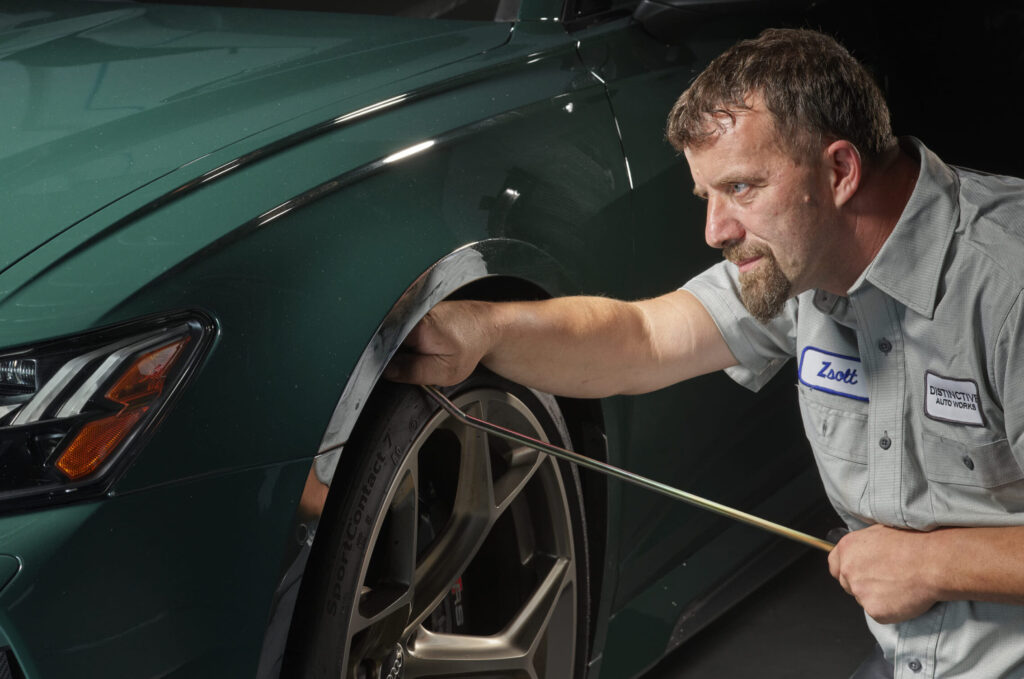
When we talk about resale value, repair quality is not only about making the vehicle look good; it’s about restoring the way the vehicle performs, how it protects occupants in a future collision, and how well it holds up over time.
Appraisers and informed buyers often look for clues in three areas: parts choice, fit and finish, and evidence that the safety systems were restored correctly.
Parts choice matters because OEM parts are designed to match the vehicle’s original tolerances, attachment points, and crash behavior, while aftermarket parts can vary in fit and material quality even when they look similar at first glance.
On luxury vehicles, slight differences show up as panel gaps, wind noise, water leaks, inconsistent headlight alignment, or trim pieces that never sit perfectly flush. Those issues often become negotiation points during trade-in, and they can also create the impression that the repair was done to a price instead of to a standard.
Fit and finish matter because buyers judge what they can see, and paint is the easiest place for a repair to give itself away. Colour match has to hold in different light, not only under shop lights, and the surface texture should look consistent across adjacent panels.
When the clearcoat looks wavy, when the orange peel doesn’t match factory texture, or when you see overspray on rubber and trim, the vehicle signals “repaired,” and the market usually responds by lowering the price.
Modern safety systems add another layer. Many luxury vehicles rely on ADAS features such as forward collision warning, adaptive cruise control, lane keeping, parking sensors, and camera-based systems. After a collision, these systems often need scanning, aiming, and recalibration, and if those steps aren’t performed and documented, you can end up with intermittent warnings, features that don’t behave correctly, or failed inspections during a pre-purchase check.
Even if the car drives fine day to day, a buyer who knows what to ask for will want calibration proof, and without it they’ll assume the work was incomplete.
At DAW, we use manufacturer-approved processes and advanced equipment that supports precision repair, including Celette benches for structural accuracy, controlled aluminum repair processes for modern body construction, and refinishing systems built for high-end colour matching and durability.
Protect your resale value. Schedule your repair with DAW’s OEM-certified specialists.
OEM-certified repairs protect long-term value
OEM-certified collision repair does not erase vehicle accident history, but it often reduces the long-term penalties that come from uncertainty, because the work follows the manufacturer’s repair procedures and uses the tools and training required to restore the vehicle as closely as possible to pre-accident condition.
Certified programs matter for a few reasons.
First, they require technicians to follow brand-specific repair methods, which is essential when materials vary between models and years, especially with aluminum repair, mixed-material construction, and complex bonding and riveting systems.
Second, they support OEM parts usage and correct corrosion protection steps, which helps preserve durability.
Third, they create a repair trail that is easier to defend during appraisal, because the documentation ties back to recognized standards instead of vague descriptions like “repaired as needed.”
This is why documentation becomes part of value. When you can show a detailed parts list, repair invoices, photos, scan and calibration reports, and any measurement or alignment printouts, you give a future buyer less room to assume the worst.
Dealers also tend to move faster through appraisal when the repair file is clean and complete, because it reduces guesswork about the quality of the work.
Learn more about DAW’s OEM certifications.
Factors that affect how much value you lose
How much resale value drops after a collision varies, but there are a few patterns that show up consistently.
Vehicle age and mileage
Newer, lower-mileage vehicles often take a bigger hit after an accident because buyers expect a clean record at that price point, while older vehicles may see a smaller relative change because depreciation is already doing more of the work.
Brand expectations and buyer standards
Luxury buyers pay for precision, and the market tends to punish anything that suggests compromise, especially on brands where owners expect strict maintenance and flawless condition.
Type and location of damage
A bumper repair is not the same as damage affecting structure, suspension, or safety systems. Structural damage depreciation tends to be higher because it carries more long-term questions.
Repair documentation
Strong documentation reduces the “unknowns” factor, which is where most resale penalties come from.
Paint match, panel alignment, and finish quality
These are the visible signals buyers use to decide whether they trust the repair.
Parts used
OEM parts vs aftermarket often becomes an appraisal lever, and it can show up as lower trade-in offers when the dealer sees non-OEM parts on a vehicle where OEM fit matters.
How to maintain value after a collision
If you want to protect your vehicle’s resale value, focus on the decisions you control from day one of the repair.
Choose an OEM-certified shop for your make
This gives you the best shot at restoring factory integrity, especially on luxury vehicles with aluminum repair needs, complex materials, and tight tolerances.
Learn more about Distinctive Auto Works’ services.
Ask for a complete repair file
Request a detailed invoice with parts listed, plus scan and calibration proof for ADAS systems, and photos that show key stages of the work, because these items help later when a buyer asks what was repaired and how.
Inspect the vehicle carefully before you accept it
Check panel gaps and shut lines in daylight, look at reflections down the side of the car, confirm warning lights are off, and take a highway drive to listen for wind noise and confirm the vehicle tracks straight.
Be strategic with small cosmetic claims
For minor damage, consider the tradeoff between paying out of pocket and adding a claim record, especially if you plan to sell soon, because the record itself can influence buyer confidence even when the repair is simple.
Keep maintenance records after the repair
A complete service history reassures buyers who worry that a repaired vehicle might come with future issues.
To understand the technology behind high-end repairs, read our recent article.
How DAW protects your investment
Luxury vehicle restoration demands more than a clean paint job. It requires structural precision, correct materials and parts, proper corrosion protection, and documented scans and calibrations so the vehicle performs the way it was designed to perform.
At DAW, we focus on restoring factory integrity and supporting resale confidence with clear documentation, strong workmanship standards, and a repair process built around OEM expectations.
We also coordinate closely with insurance to keep the process smooth, reduce delays, and ensure repair steps aren’t skipped or rushed when timelines get tight.
Learn what it’s like to repair with DAW here.
FAQs about resale and repairs
Does an insurance claim affect resale value?
An insurance claim often affects resale value, because the claim can show up in your vehicle accident history and change buyer perception. The impact depends on the damage severity, the repair quality, and how well you can document what was done.
Will my luxury car ever look the same after repairs?
A high-quality repair can restore fit and finish to a level most buyers won’t notice, but the difference comes from the process: OEM parts, precise structural work, careful refinishing, and proper calibration.
How much value does an accident take off?
There isn’t one number that fits every vehicle, but accidents tend to reduce luxury car resale value more when the vehicle is newer, the damage is structural, or the repair quality and documentation are unclear.
Can I recover diminished value?
Diminished value claims in Canada depend on the situation and the province, and recovery is often tied to the at-fault party rather than your own policy. If you want to explore it, keep strong documentation, consider an appraisal or market comparison, and speak with your insurer or a qualified professional about your options.
Related Articles
View All ArticlesOther
Other
Are Luxury Cars More Expensive to Insure in Canada?
Other

Repairing Tesla Body Damage The Right Way
Other

The Luxury Auto Body Repair Technology Most Shops Don’t Have
Other
Do All Luxury Cars Really Need Premium Gas?
Company Announcements
Distinctive Auto Works Edmonton Is Moving — Just Down the Street!
Other
A Class Above
Other

Customer service excellence at Distinctive Auto Works
Other
All the Fixings: Distinctive Auto Works Edmonton